San Rocco and Antonio’s chapel
San Rocco and Antonio’s chapel stands in the homonymous village, on the border of Verzuolo. It was built in 1631, after the vow made by the community during the plague of the previous year. The chapel opens during the celebration of Saint Antonio, in January, and Saint Rocco, the last Sunday of august.
The façade is simple, in brickwork, with four pilasters and two windows with a round arch (arco a tutto sesto). On the façade we have the central front door, decorated with marble, and above, a lunette decorated with angels, Eucharistic symbols and a Latin inscription which indicate to whom the chapel has been dedicated.
The chapel has a rectangular map, a little bell tower close to the roof and a lot of decoration and frescos on the inside.
The ordinary and extraordinary maintenance of the chapel is entrusted to the massari and to the association “Friends of Saint Rocco”.
In the Church we have two celebration: in the end of January, the closest Sunday to Saint Anthony (17 January) there is a religious function and the traditional “incanto”, a sort of auction where are offered animals and local products (and the proceeds is devolved to the chapel); and the penultimate Sunday of August, San Rocco is celebrated with religious functions, dances, a dinner for the community and games for children.
Curiosity
San Rocco...and his dog
Those who loved or love a dog know it well: this animal gives us more than what we give to him and it often gives us more than what people give us.
This is also happened to San Rocco, one of the post popular saints healers of the West.
All invoked him between the Middle Ages and the nineteenth century on the occasion of fears and the renewal of plague epidemics.
San Rocco is therefore also one of the most represented western saints.
They represented all kinds of artists: both those simple folk art, as some of the most popular as Tintoretto, Michelangelo, Ludovico Carracci, Guido Reni, Botticelli.
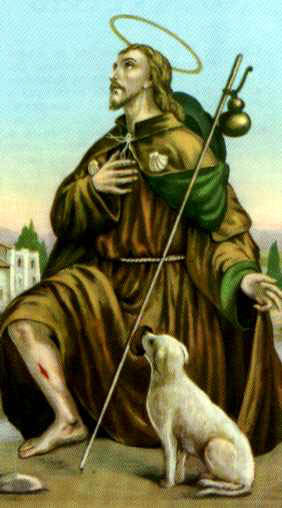
And everyone has painted it or carved it the same way, in a way that serves to remember his story, the story of a pilgrim, with cane, cape, saddlebag, sandals, which goes, despite a sore on the leg, that walks in the company of a dog, his only friend.
Rocco wasn’t Italian, but French. . He was born in Montpellier in a wealthy family of the big mercantile bourgeoisie between 1345 and 1350.
According to tradition, once the parents died and donated all their wealth to the poor, he left France and set off for Italy.
He chose Italy, where pestilences and wars were raging, because, along the way of pilgrimages, the so-called Via Francigena, hoped to better achieve its purpose: to treat sick pilgrims, to console them, but above all to alleviate the suffering of plague victims. , of those derelicts, that is, that nobody wanted, of those unfortunates for whom there were no hopes.
Going up and down Italy worked for years in favor of these patients and also worked healings considered miraculous. But in Piacenza, where he arrived in July 1371, while he was assisting the sick of the plague of the Hospital of Santa Maria di Betlemme, he became ill himself. Tormented by a painful bubo in the groin, not only did not find anyone willing to treat him, but even found himself expelled from the other sick, tired of his complaints. Dragged to Sarmato (17 km from the city), Rocco took refuge in a cave to wait for death.
It was a dog that saved him. The beast, aware of his presence and his suffering, brought him a piece of bread every day, until his recovery.
San Rocco once healed, he did not return to France, but resumed his activity in favor of the plague victims for whom he is still remembered today.
And his dog followed him. A dog has so much love to give and there is always someone who needs it: even a saint.
They have certainly understood this in the hospices in Bologna where every guest who wishes can adopt an abandoned dog.